Does Turnitin Detect ChatGPT? Here's What Actually Happens
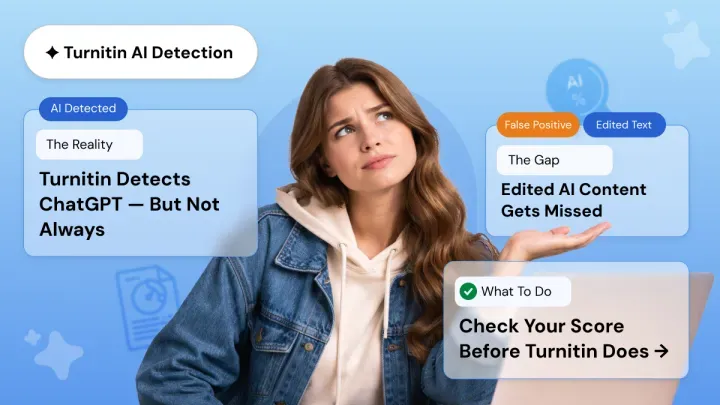
Every student who has ever typed something into ChatGPT and copied and pasted it into a Word doc has wondered the same thing: Does Turnitin detect ChatGPT?
Yes, Turnitin can catch you. But there’s a lot more to this story than you might think.
Turnitin's AI detection is not your typical plagiarism checker.
It's an advanced pattern-recognition system, and knowing how it works, where it does well, and, most importantly, where it doesn't can mean all the difference between passing it clean and getting pulled into your professor's office.
Just before you click “Submit,” you should understand what’s really going on behind the scenes.
Run your content through Phrasly AI Detector before you press submit so you know where you stand. Then read on to learn what Turnitin is really looking for.
Does Turnitin Actually Detect ChatGPT?
Yes! Turnitin can detect ChatGPT-generated AI writing. Turnitin’s AI writing detection technology works by looking for patterns in text that match what it knows about ChatGPT, GPT-3, GPT-3.5, GPT-4, GPT-4o, GPT-5 and other large language models (LLMs).
But there’s more to the story than that headline lets on. Real-world accuracy will depend greatly on how the text was written and edited. Turnitin does not have “ChatGPT” or anything like that on its database to detect.
It compares your writing to the statistical chances of certain writing being generated by AI.
There are two distinct categories:
- AI-generated text: Content likely written directly by AI
- AI-paraphrased text: Content that appears AI-generated but has been edited or rewritten
Each of these is assessed separately within Turnitin’s AI-generated report. Simply rewriting text that was originally generated by AI will not make that content unidentifiable. One limitation is that Turnitin only analyzes prose written in paragraphs.
It typically does not analyze:
- Bullet points
- Code blocks
- Tables
- Very short or fragmented text
You might also realize that certain parts of your assignment will not go through AI detection whatsoever. Turnitin has claimed its AI detector is 98% accurate. However, there’s a caveat to that statistic:
It primarily holds true for raw AI-generated text.
The real world of academia is almost never this straightforward. Students usually:
- Edit AI output.
- Mix AI with their own writing.
- Rewrite sections in their own words.
Detection rates are lower for these cases. Turnitin won't catch:
- Detecting edited AI content
- Avoiding false positives on genuine human writing
While Turnitin may catch ChatGPT easily, it’s much less reliable when it comes to edited, real-world submissions.
What AI Models Does Turnitin Detect?
Turnitin isn't just looking for ChatGPT. Turnitin's detection system is trained to recognize writing patterns from across a wide range of AI models. These include GPT-3, GPT-3.5, GPT-4, GPT-4o, Google Gemini (e.g., Gemini Pro), and Meta LLaMA.
Turnitin also said it would expand detection for new AI systems as they're released. Note that there has been no confirmation that it detects future/unreleased systems specifically, e.g., "ChatGPT 5". Claims to that effect are currently unverified.
How Does Turnitin Detect ChatGPT?
Turnitin identifies ChatGPT based on linguistic patterns found in your writing, not from copied sources. Turnitin evaluates how predictable, consistent, and structured your writing is to determine the likelihood that it was written by AI versus a human.
Rather than asking “Where did this text come from?” Turnitin asks:
“Does this text act like AI-generated text?”
Turnitin tends to be overly-cautious and conservative compared to most 3rd-party AI detectors (i.e. It wants to avoid false positives). Like everything else, its efficacy decreases with edited or blended (AI + human) text.
Perplexity and Burstiness Explained
Perplexity is a measure of how predictable your word choices are. Tools like ChatGPT are very predictable. Their sentences contain the most statistically likely next word. Human writing is often less predictable.
We rephrase things, take risks, and shift our tone.
Burstiness measures how different your sentence lengths and patterns are. Human writing has short sentences, Long sentences with many parts, and some sentences that might not flow perfectly. AI writing seems very smooth and consistent.
Its sentences are usually around the same length.
Text Segmentation
Turnitin doesn’t analyze your whole document at once. Instead, it breaks your writing into smaller overlapping segments (typically 5–10 sentences long).
These segments are scored on a scale from:
- 0 🡪 Likely human-written
- 1 🡪 Likely AI-generated
Turnitin takes your scores for each section and averages them together to create your final AI percentage. That's why having some sections flagged as AI can increase your overall score, and why edited or combined text can still be flagged.

